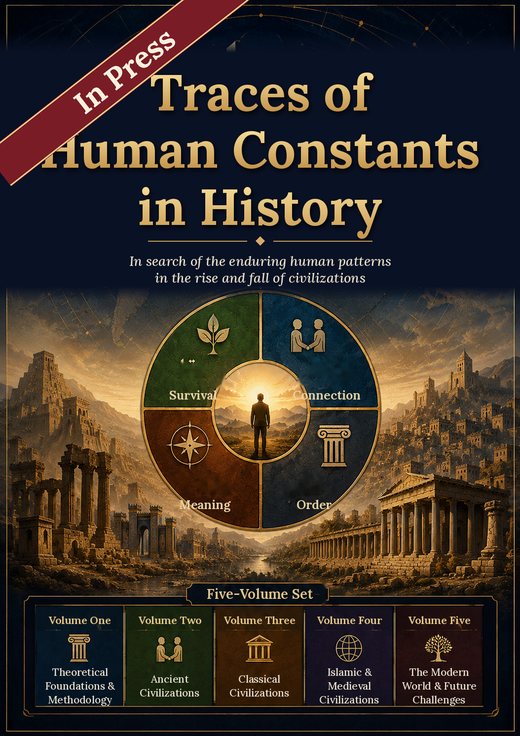
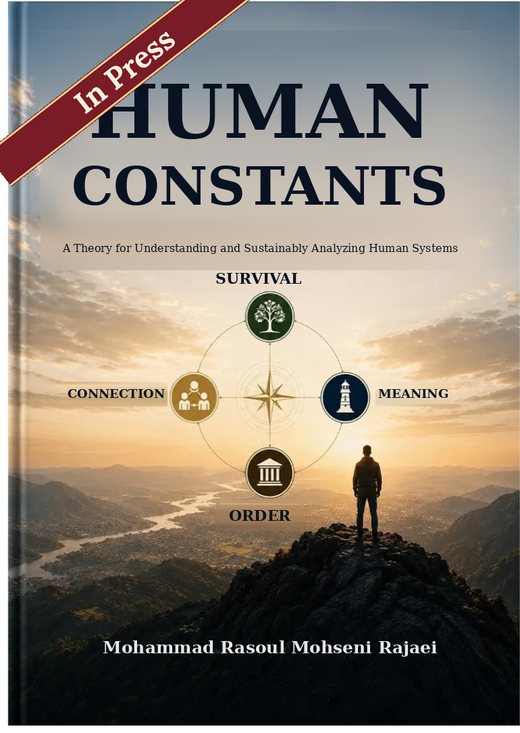
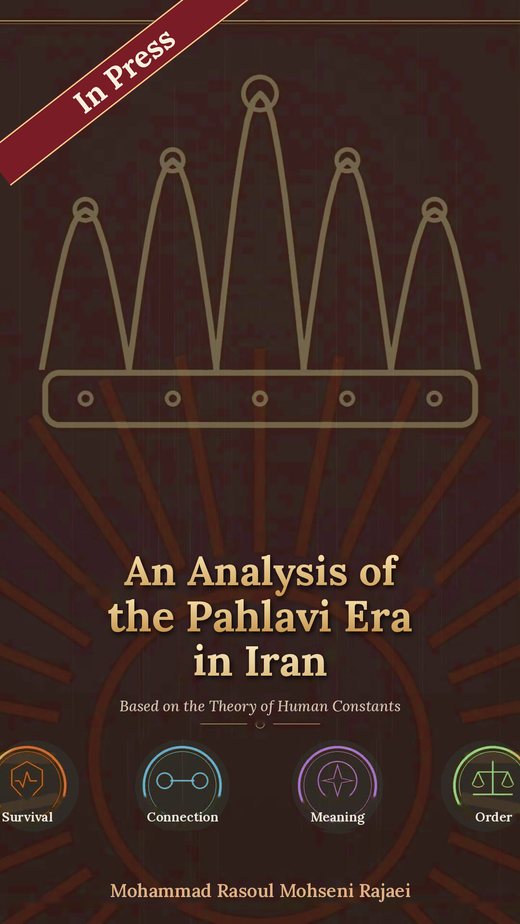
Traces of Human Constants in History is an extensive interdisciplinary study of the history of civilizations from a different perspective. The book is founded on a fundamental question:
Can fundamental and recurring needs and processes be observed beneath the immense historical, geographical, and cultural differences among human societies?
The Book’s Central Framework
The book’s central framework is grounded in Human Constants Theory. According to this theory, four fundamental domains have consistently mattered in individual and collective human life: survival, connection, meaning, and order. These constants are not independent or isolated; they operate within a dynamic, interactive system. A change in one can affect the other three and influence the stability or crisis of a society.
From this perspective, history is not merely a sequence of wars, monarchs, revolutions, and collapses. It is also a field in which we can observe how human beings seek resources, establish connections, create meaning, and organize collective life.
The Five-Volume Structure
The work is arranged in five volumes so that its extensive historical and theoretical material can be presented in an organized structure without omitting its essential content.
Volume One addresses the theoretical foundations, methods of studying history, definition of the four constants, analysis of historical events, initial tests of the theory, measurability, and comparative method.
Volume Two turns to the direct study of civilizations, following the historical path from Elam, ancient Egypt, and the Achaemenids through Greece, Rome, and the Middle Ages. The Achaemenid question is examined through the lens of “order across diversity.”
Volume Three examines civilizational transformation from the Renaissance to the modern world, from the scientific and industrial revolutions and the World Wars to the Cold War, the digital revolution, artificial intelligence, and the question of civilization’s natural limits.
Volume Four presents extensive comparative studies of civilizations, from Mesopotamia, Egypt, Iran, Greece, and Islamic civilization to Europe, modern civilization, and contemporary civilization. It places the theory before diverse historical cases in order to assess its explanatory power.
Volume Five moves from history toward modeling and testing the theory. It examines comparative testing, the four-constants model, measurement, a civilizational health index, civilizational crisis, warning signs, the future of civilization, artificial intelligence, the theory’s openness to criticism, and an empirical research program.
The Book’s Approach
The book does not claim that the four constants are the sole causes of historical events. On the contrary, one of its central principles is that history must be able to challenge the theory. Each civilization is therefore studied through relationships among geography, resources, economics, population, technology, power, institutions, war, communication, systems of meaning, the natural environment, and political structure. The aim is not to replace historical complexity with a simple cause, but to offer a shared analytical framework for comparing diverse human experiences.
Why “Traces”?
The title arises from the idea that human constants do not necessarily appear in history under their own names. They may take the form of irrigation systems, markets, laws, armies, religions, families, roads, cities, universities, states, technologies, communication networks, or political institutions. What changes over time is the form in which these needs appear; the fundamental questions of human beings, however, remain:
How do we survive?
How do we connect with one another?
How do we create meaning in life?
How do we organize our shared life?
The book seeks to follow the traces of these questions across the long course of civilizational history.
An Open and Testable Inquiry
A defining feature of this work is its emphasis on the theory’s openness to criticism and empirical testing. The book does not regard itself as the end of the discussion about history, but as the beginning of a research program that can continue through the study of more civilizations, more precise historical data, quantitative indicators, and broader comparisons. If historical evidence fails to support part of the theory, the theory must be revised. Its value therefore lies not in offering a final answer, but in generating more precise questions and more demanding tests.
Intended Readers
This collection may be useful to researchers and readers interested in history and civilization, sociology, the philosophy of history, political science, economics, civilizational studies, systems theory, futures studies, and artificial intelligence.
Traces of Human Constants in History is an attempt to view history from an angle that does not deny the differences among civilizations, yet searches within those differences for fundamental and recurring patterns of human behavior. Civilizations change; states rise and fall; technologies transform; but the human problem of building and sustaining a shared life remains. From this point, the study of history can become a study of humanity.