Book Introduction
Six Centuries of Thinking About Transformation is a journey through six centuries of reflection on one of humanity’s enduring questions: how do societies change? Through a comparative review of eighteen major thinkers, from Ibn Khaldun to Harari, the book traces the development of social theories and shows how these thinkers, despite their historical and intellectual differences, sought answers to shared questions.
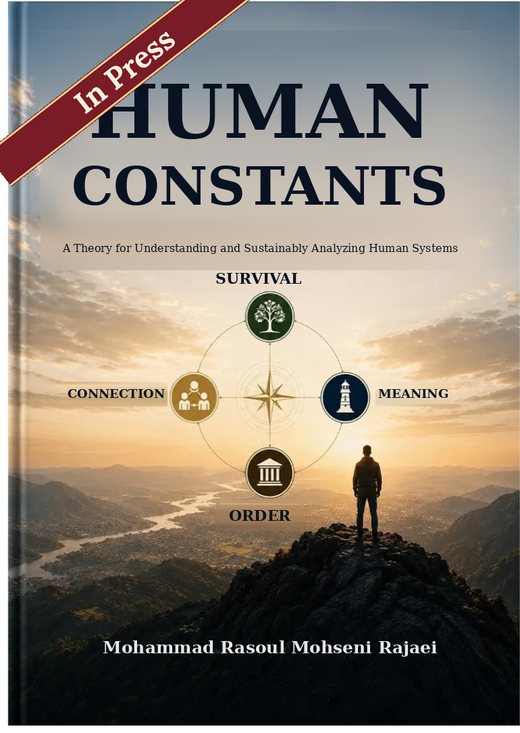
At the conclusion of this comparative survey, the author rereads the ideas of these eighteen thinkers through the lens of Human Constants Theory, a framework that analyzes the behavior and organization of human societies around four fundamental axes: survival, connection, meaning, and order. The result is not merely a historical account of an intellectual tradition, but an attempt to identify enduring patterns beneath the diversity of theories of social change.
Written for readers interested in historical sociology, the philosophy of the human sciences, and civilizational studies, the book seeks to build a bridge between academic rigor and accessible prose.
Book Summary
In comparative form, the book examines the ideas of eighteen influential thinkers on social change. Over the past six centuries, each approached the question of transformation in human societies from a different angle. For each thinker, the author explains the theory’s central core, the historical context in which it emerged, and its relationship to earlier and later ideas.
In the final section, these diverse ideas are brought together for comparative analysis through the framework of Human Constants Theory. This framework proposes that, beneath historical and cultural differences, relatively stable patterns exist in the four domains of survival, connection, meaning, and order, patterns that can be traced across different theories of social change.
The result is a conceptual map that enables readers to view the theories of the past six centuries not as a collection of disconnected perspectives, but as ideas in dialogue with one another within a unified framework.